The world’s first "Omicron" picture was released, and Zhong Nanshan and others voiced.
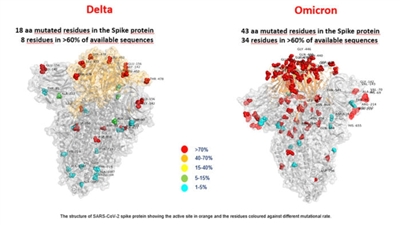
Comparison of spike protein mutation between Delta strain and Omicron strain (picture from Rome Children’s Hospital)
■ On November 27th, local time, the research team of Rome Children’s Hospital released the world’s first picture of Omicron, a new mutant strain of Covid-19.
■ The picture shows that compared with Delta strain of COVID-19 mutant virus, Omicron strain has more spike protein mutations. These variations are diverse, and most of them are located in the areas that interact with human cells.
■ Researchers say that Covid-19 has adapted to the human body through mutation, but it doesn’t necessarily mean that it has become more dangerous.
The first case of Omicron virus infection occurred in Italy.
On November 27th, local time, Italy confirmed the first case of Covid-19 mutant strain Omicron infection by laboratory sequencing. Italy’s "Corriere della Serra" reported that the patient lived in Campania region in southern Italy and returned from a trip to Mozambique. He had previously tested positive for Covid-19 and was isolated, and now he is in good health.
On November 26th, local time, the Italian Ministry of Health has decided to ban people who have stayed in eight African countries including South Africa and Zimbabwe in the past 14 days.
Peter Hotz, a professor at Baylor Medical College in the United States, said: "We often lack mobility in the process of sequencing virus genes, so I wouldn’t be surprised at all if the new mutant has spread to the United States."
Where did the mutant strain come from?
Researchers are studying it.
With the spread of Omicron mutant, researchers are also studying where it came from. Franç ois Balu, a professor of biology at University College London, UK, said that Omicron mutant carries a series of unusual mutations, which may occur during the chronic infection of an immunocompromised patient or may come from an untreated AIDS patient.
Risk assessment of new mutant
More experimental data are still needed
Compared with Delta virus, where is the greater danger of the mutant strain "Omicron"? Will it trigger a wider spread?
According to Russian TV today, at present, Omicron mutant is spreading in Africa and outside Africa at an alarming rate.
Take South Africa as an example. Recently, 90% of the newly infected cases in gauteng province, South Africa are related to this mutant. Many western media believe that Omicron mutant is the most dangerous Covid-19 mutant in the world.
The researchers said that the Delta mutant strain discovered in India last October contained a total of 15 mutations, and the World Health Organization listed it as a "mutant strain that needs attention" in May this year; According to the preliminary study, the Omicron mutant, which is also listed as a "mutant that needs attention" by WHO, has more mutations than the Beta strain. At present, it is known that the mutant carries at least 32 mutations, which means that the effectiveness of the existing COVID-19 vaccine may be weakened and it may be more infectious.
WHO officials said that at present, little is known about this new mutant strain, and more experimental data are still needed to evaluate whether it is more infectious or more resistant to vaccines.
Who asks countries
Strengthen monitoring and sequencing.
How to prevent and control the new Covid-19 mutant? At present, the World Health Organization has asked countries to strengthen the monitoring and sequencing work, and called on countries to strengthen the monitoring and sequencing of all COVID-19 mutant strains that are still prevalent, submit the complete virus genome sequence and metadata to the public database, and report to WHO the initial cases or case clusters related to any mutant strains that need attention.
WHO also suggested that international cooperation should be carried out to better understand the various impacts of the mutant strains that need attention through field investigation and laboratory evaluation.
At the same time, some countries are worried that this new mutant strain will trigger a new wave of fierce epidemic after the Delta strain. Up to now, about 20 countries have issued or are preparing to issue entry restrictions for flights and passengers in southern African countries.
Foch/
Omicron strain
Or has existed in the United States and has not yet been discovered.
According to a report by CNN on November 27th, local time, Anthony Fauci, director of the National Institute of Allergy and Infectious Diseases, said that Covid-19 mutant strain Omicron may have appeared in the United States, but it has not been discovered.
The U.S. Centers for Disease Control and Prevention said on November 26th that so far, no known cases of Omicron strain infection have been found in the United States. If the mutated strain appears in the United States, the U.S. Centers for Disease Control and Prevention expects to quickly confirm the cases through the monitoring system.
US President Biden announced on November 26th that the United States would restrict the entry of tourists from South Africa, Botswana, Zimbabwe, Namibia, Lesotho, Swaziland, Mozambique and Malawi from November 29th.
Influenced by Omicron strain.
The US government advised people not to travel to eight African countries.
On November 27th, local time, affected by Covid-19 mutant strain Omicron, the Centers for Disease Control and Prevention (CDC) upgraded the travel risk index of eight African countries, namely South Africa, Zimbabwe, Namibia, Mozambique, Malawi, Lesotho, Swaziland and Botswana, to "level 4", which means "very high".
On the same day, the State Council also issued a warning to the public, suggesting not to travel to the above eight African countries.
Zhong Nanshan, Zhang Wenhong and Wu Zunyou voiced/
Omicron strain poses more challenges to epidemic prevention.
According to the Southern Plus, Zhong Nanshan introduced in an interview on November 28th that from the current situation, the Omicron mutant has spread rapidly, and it has been popular in South Africa and other regions, and cases have been found in Hong Kong, China recently. "This mutant is very new. Although molecular genetic testing has found that it has many changes in the receptor binding site, how harmful it is, how fast it will spread, whether it will make the disease more serious, and whether it needs to be targeted. Vaccine research and development depends on the situation. It is too early to draw conclusions. "
Zhong Nanshan said that it will take some time to judge the harmfulness of Omicron mutant, and we need to pay attention to it at any time, but we won’t take any big action yet. "There is also a need to pay more attention to the prevention and control of personnel from relevant places in South Africa."
Earlier, Zhong Nanshan also said on the 27th that there is not much knowledge about this variant virus, but this virus carries a lot of mutations, which also poses more challenges to epidemic prevention.
At noon on November 28th, Zhang Wenhong also issued a Weibo to respond to the influence of the new mutant strain. Zhang Wenhong said that it can be judged that the emergence of the mutant virus in South Africa is accidental, but it will take about two weeks to observe whether it will pose a threat to the current fragile population immunity.
According to the Beijing News, on November 28th, Wu Zunyou, chief epidemiologist of China Center for Disease Control and Prevention, said that the epidemic situation is the most serious in the world, mainly in Europe, and the prevalent strain this winter and next spring is mainly Delta. Whether the mutant strain Omicron can develop into the dominant strain needs further close observation.
Wu Zunyou said that Omicron, a mutant strain discovered in South Africa, is a new mutant strain, with more mutation sites than the previous ones, reaching 32 mutation sites. The mathematical model shows that Omicron is more contagious than the Bedelta, but no matter how it mutates, public health measures such as wearing masks and keeping social distance are effective for all mutated strains.
(Comprehensive Xinhuanet, national business daily)
More than 20 countries have taken restrictive measures.
The discovery of Omicron strain in South Africa and other countries has aroused great global vigilance. Up to now, the governments of about 20 countries and regions have successively issued or prepared to issue entry restrictions for flights and passengers in southern African countries.
Among them, the British government said on the 26th that from that day on, flights from South Africa and five neighboring countries were prohibited from entering the country, and people with relevant travel history were required to undergo nucleic acid testing and isolation. On the same day, Switzerland announced that it would ban all direct flights from Botswana, South Africa and other countries indefinitely.
On November 26th, local time, the Italian Ministry of Health has decided to ban people who have stayed in eight African countries including South Africa and Zimbabwe in the past 14 days.
German disease control agencies have classified South Africa as a "virus mutation area", and all people who enter Germany from South Africa must be quarantined for 14 days, regardless of whether they have been vaccinated or not.
According to the notice issued by Pakistan National Command and Operation Center on November 27th, Pakistan issued a travel ban on passengers from South Africa, Lesotho, Swaziland, Mozambique, Botswana, Namibia and other regions.
In addition, Russia also announced that it will ban foreign citizens from South Africa and other countries and regions from the 28th of this month.
Health Canada also announced on 26th that it will ban foreign citizens who have been to southern African countries in the past 14 days.
Israel has banned its citizens from traveling to southern Africa after discovering new cases of mutant virus infection in its territory. On the 28th local time, Israel decided to ban all foreigners from entering the country, and the ban will last for 14 days.
Singapore and Malaysia announced on the 26th that they would ban the entry of passengers who have recently visited seven countries including South Africa.
The Indian government has issued a reminder, suggesting that local governments should carry out Covid-19 testing and health screening for international travelers from South Africa and other "risk zone" countries.
Japan has also implemented measures to ground inbound flights and isolate passengers for countries such as South Africa. In response to the travel ban issued by many countries around the world, the South African government responded on the 26th that it is harsh and unscientific to impose travel restrictions on passengers from South Africa, which is also inconsistent with the recommendations of WHO. (CCTV News)