Humanistic Economics Behind Su Chao’s Going Out of the Circle
This summer, Jiangsu City Football League (referred to as "Su Chao") became popular. Since the start of the competition on May 10th, the influence of "Su Chao" has been rising continuously, with a maximum attendance of 60,000 people in a single game, an average of millions of people grabbing tickets in each round, and the cumulative spread of short video platforms exceeding 10 billion times, kicking out the "world wave" that broke the circle.
Why is "Su Chao" out of the circle? There are a lot of interpretations about Jiangsu’s stubble-making, grounded competition and city soft power’s strength, which basically belong to the category of human economics. Behind the popularity of "Su Chao" is the powerful energy generated by the deep integration of regional culture and economic kinetic energy, which contains profound humanistic economic logic.
During the two sessions of the National People’s Congress in 2023, the General Secretary of the Supreme Leader pointed out when attending the deliberation of the Jiangsu delegation: "Where the culture is very developed, the economy is still ahead. You can study the human economics here. " Humanistic economics is not a simple superposition of culture and economy, but a benign interaction and complementarity between humanities and economy, which injects surging momentum into high-quality development.
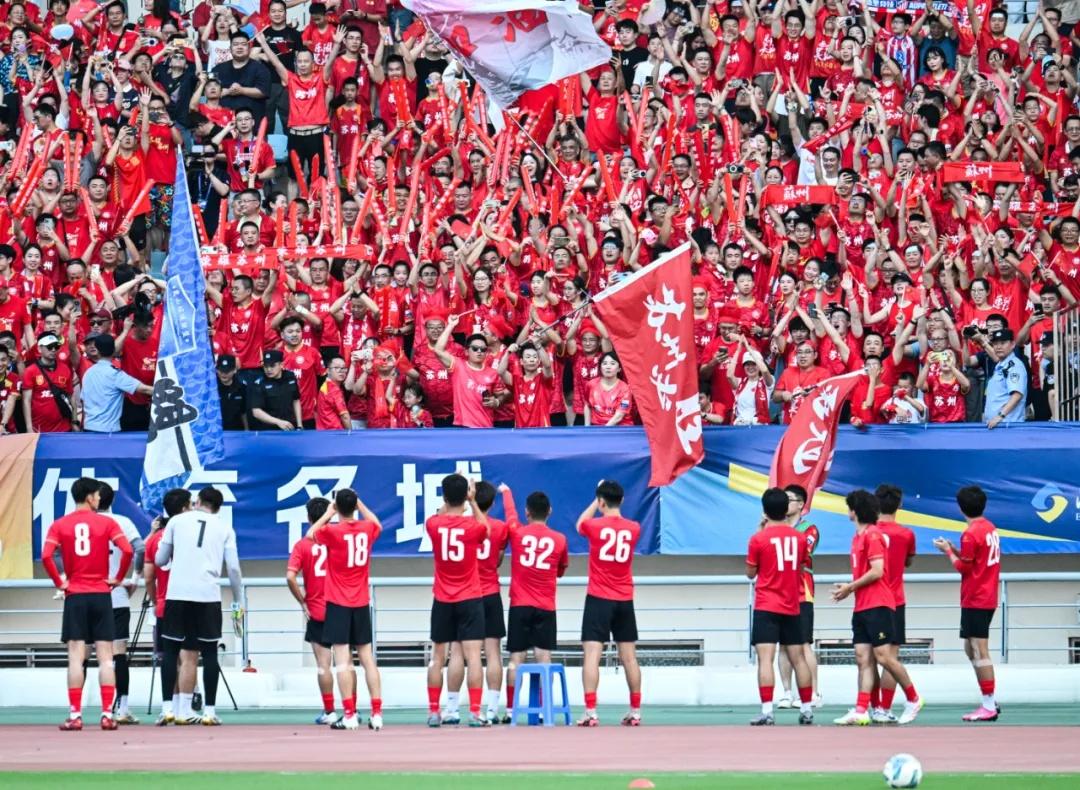
On July 5, 2025, in the sixth round of the 2025 Jiangsu City Football League held in Nanjing, Jiangsu, Nanjing drew 0-0 with Suzhou at home. The picture shows that on the same day, Suzhou team players paid tribute to the fans before the game. Xinhua News Agency reporter Ji Chunpeng/photo
"Su Chao" is a vivid case of Jiangsu’s practice of humanistic economics. Different from the traditional competition system with professional clubs as the mainstream, "Su Chao" teamed up in the name of a city, giving 13 cities in Jiangsu their own "home teams", stringing the cultural pearls of different districts and cities into necklaces, forming a city IP, which shines on the pitch. The atmosphere at the scene is super-burning, the cultural characteristics are super-stalked, and the industrial linkage hyperlink. The fulcrum of "Su Chao" is not only the football itself, but also the competition and cooperation of cities, the collision of cultures and the flow of economy. It is predicted that "Su Chao" will create comprehensive economic benefits of over 300 million yuan in the whole season, with an average income of more than 20 million yuan per city.
With the popularity of the "Su Chao" event, Jiangsu’s investigation and study were omitted, and some people proposed "copying homework" to launch more "Su Chao" events. The success of "Su Chao" should be learned from, but not simply copied. Every place has its own unique cultural background, development foundation and resource endowment, and only by adapting measures to local conditions can it create its own "Su Chao". We should grasp the essence of humanistic economics, adhere to people-oriented, promote cultural economization and economic culturalization, realize the integration, empowerment and common prosperity of culture and economy, and play a good role in the "humanistic economy" of our city.
To develop humanistic economy, we should highlight the value and function of "people"."Su Chao" attracts the general public to participate with the positioning of "Happy Football" and "Grass-roots Football". More than 60% of the players are from ordinary posts such as teachers and couriers. The ticket price around 10 yuan makes football return to the streets. In fact, the popularity of Harbin Ice and Snow World, "Charming Chongqing" UAV Light Show, Zibo Barbecue, etc. lies in meeting people’s demand for characteristic culture, trendy experience and emotional value. Only by working hard to respect, satisfy and achieve people can we write a good article on "Human Economics".
To develop humanistic economy, we should fully display cultural characteristics and strength.The popularity of "Su Chao" is mainly due to the activation of profound humanistic heritage. From "14th Friendship" to "Stroke Guarding War", from "Chu-Han hegemony" to "Morning Tea Derby", from "Battle between South Colombia" to "Battle of Taihu Lake" ….. The endless jokes of folk stalks and official stalks reflect Jiangsu’s multicultural ecology and strong cultural self-confidence. Cultural inheritance and development contains the potential of economic growth. Fully tap their own historical and cultural resources, combine local resource endowments, and carefully create unique cultural tourism projects and boutique activities, so as to prosper with literature and continuously transform cultural advantages into economic advantages and development advantages.
To develop humanistic economy, we should be steady and far-reaching in creating economic benefits.In the first six rounds of "Su Chao", only five aspects, such as tourism, travel, catering, accommodation and sports, brought in nearly 38 billion yuan in revenue. Some netizens lamented that "Su Chao" still has "the ability to make money". When more and more people are willing to pay for a good experience, the development of humanistic economy must meet people’s needs in all directions and at multiple levels, and fully consider economic factors such as cost, flow and income, expand consumption scenarios, pay attention to creative marketing, and explore cross-border linkage. While people get a good consumption experience, they will drive the local economy and promote the sustained and healthy development of humanistic economy.
The profound meaning of humanistic economics lies in the formation of the development trend of harmonious development of humanistic prosperity and economic prosperity. "Su Chao" is a mirror that reflects the vivid appearance and broad prospects of humanistic economics in the new era; "Su Chao" is another kindling, which is giving birth to more humanistic economics practices with temperature, story and vitality.
(Editor: Chen Youyong Audit: Wang Zhaobin)
Reporting/feedback