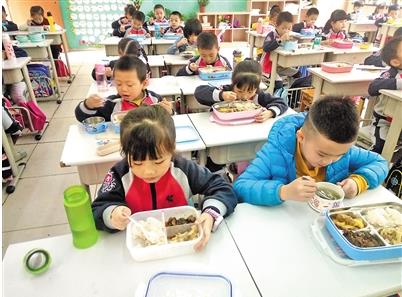
Primary school issued a "good habit manual": 10 good habits of children need to be recorded.

  Get up in the morning and say to your family, "Good morning." Go to bed at night and say "good night" to your family.

  When I go out and come home, the child will say, "I’m back." Expecting to go out will also take the initiative to say, "I’m going out for a while."

  When eating, please ask your elders to sit down first. After eating, you should say, "Eat slowly."

  … …

  This semester, Airport Xincheng Primary School in Yubei District issued a "Good Habits Manual" to the first-grade students, which listed 10 good habits and asked parents to record their children’s implementation for 21 days. At first, parents felt headache. After all, some good habits may not be possible for them. Parents insist on doing it with their children, and the changes in their children surprise parents. In the past two days, many committees and friends have been discussing this matter hotly, and feel that the "Good Habit Manual" launched by the school is grounded, which is more practical than the requirements in the past.

  Elementary school students’ entry-level "good habits"

  First-year freshmen are the key period to form good habits. Before the start of school, Airport Xincheng Primary School prepared a Record Book of Habit Formation for every new first-year pupil.

  Parents say that the school requires children to do ten things every day at home: first, go to bed on time; Second, say "good morning" to your family when you get up in the morning; Say "good night" to your family when you sleep at night; Third, when you go out or go home, you should take the initiative to say hello and say, "I’m back" or "I’m going out for a while"; Fourth, work before eating, ask the elders to sit down first when eating, and say "eat slowly" after eating; Fifth, parents should pick up items for their parents after work and say, "It’s hard work"; Sixth, wash socks every day; Seventh, clothes and socks are clean every day; Eighth, wash your hands before reading and writing; Ninth, change clothes and put them in a fixed position, and learn to organize your wardrobe; Tenth, finish your homework on time.

  The counselor of the brigade introduced in detail that the school has layered the good habit manual, and the specific content of good habits in each grade is not the same, each with its own emphasis. The Record Book of Habit Formation is divided into campus edition and home edition, and the highlights of recording students’ good habits are completed by teachers, classmates and parents. In order to facilitate the timely recording of pupils’ good habits and highlights in their actions, the teachers are also going to process the QR code on each student’s school card and praise it on the spot by scanning the code.

  Teacher: Good habits as class culture.

  After school in the afternoon, parents outside the campus picked up their children from school. Many primary school students jumped into the arms of their grandparents and parents, and some primary school students offered to carry their own schoolbags. These good habits have been written into the good habit manuals of many classes in this school.

  In the classroom of Class 5, Grade 1, good habits have become class culture. On the blackboard newspaper in the classroom, good habits written on white paper are posted on a leafy fruit tree, like golden fruits. Teacher Zhu Xiaohong, the head teacher, also posted a small flower for each student. Every time they practice a good habit, their small flower can be stamped with a red seal of praise.

  Zhu Xiaohong said that our class has refined the good habits of the school, requiring children to speak actively in class, to be careful when doing homework, to walk up and down the stairs to the right, to avoid playing with classmates, and to cherish public goods. It also advocates that children should take the initiative to hug and thank their parents when they see them after school.

  "The class convention is still in the process of improvement, and it will be set from many aspects such as behavior habits, study habits and civilized language. I hope that children can develop some good habits every semester, so that they will always be around when they graduate from primary school and grow up. " Zhu Xiaohong said that after a month’s practice, many students began to show some good habits, such as children queuing in turn at noon, chewing slowly at meals, basically being able to eat without saying anything, and actively cleaning desks and lunch boxes after meals.

  Parents: urge the children to change themselves.

  Parents are the ones who are most touched when they see their children form good habits day by day. During this time, parents are discussing the "Good Habits Manual" launched by the school on the Internet.

  "These habits look simple, but they are not easy to do. In fact, many of us can’t do it ourselves." A parent said that he was really "thundered" when he got the good habit manual at first.

  The teacher asked parents to record their children’s performance at home every day, and to express it with smiling faces and crying faces. A parent talked about his child’s situation, and at first read these good habits to his child one by one. They had no difficulty in understanding these sentences, but they could not persist in doing them. It seems that it is not easy for parents to let their children form good habits by reminding and urging them. A week later, after the parent discussed with his family, the whole family insisted on doing so, and slowly the child began to change.

  Many parents said that the school’s "Good Habits Manual" benefited them a lot. "These rules are neither ‘ Gaodashang ’ , but also easy to understand and imitate. Great things in the world must be done in detail and persevere. " (Reporter Ye Huang)

Ministry of Ecology and Environment: In 2022, the main stream of the Yellow River reached Grade II water quality for the first time.

  BEIJING, Beijing, February 22 (Reporter Yuan Xiuyue) What progress has been made in the management of water ecological environment in China in the past year? What are the key arrangements for the remediation of black and odorous water bodies and the supervision of sewage outlets in 2023? On the 22nd, the Ministry of Ecology and Environment held a regular press conference in February, and the relevant person in charge introduced the water ecological environment management.

  In 2022, the discharge of major water pollutants in China will continue to decline.

  Huang Xiaozeng, Director of the Department of Water Ecology and Environment of the Ministry of Ecology and Environment, introduced that in 2022, the Ministry of Ecology and Environment issued and implemented the action plan for the remediation of sewage outlets entering the Yangtze River, and the traceability of sewage outlets in the Yangtze River and Bohai Sea was completed by more than 90%, which promoted the solution of more than 20,000 sewage direct discharge and disorderly discharge. Complete the investigation of sewage outlets in the middle and upper reaches of the Yellow River and 30 cities in 6 provinces of Fenhe River Basin.

  In 2022, the discharge of major water pollutants in China will continue to decline, and the goal of improving the quality of water ecological environment will be successfully completed. The proportion of excellent surface water quality sections in China was 87.9%, up 3.0 percentage points year-on-year; The proportion of sections with inferior grade V water quality was 0.7%, down 0.5 percentage points year-on-year; For three consecutive years, the main stream of the Yangtze River reached Grade II water quality, and the main stream of the Yellow River reached Grade II water quality for the first time. Chemical oxygen demand and total ammonia nitrogen emissions decreased by 3.7% and 5.5% respectively.

  Huang Xiaozeng said that although the water ecological environment protection has achieved remarkable results, it still faces many bottlenecks and challenges, and there are still many outstanding problems and shortcomings to be solved urgently. For example, it is difficult to fundamentally eliminate black and odorous water bodies, and the water ecological environment governance capacity needs to be improved. In some places, pollution interception and pollution control are still not in place, and the problems of cyanobacteria bloom and water ecological imbalance still exist.

  This year, the country plans to complete the renovation of more than 800 large-scale rural black and odorous water bodies.

  Regarding the problem of black and odorous water bodies, Huang Xiaozeng said that in recent years, all localities have taken responsibility and worked hard to speed up the short-board of urban environmental infrastructure. Judging from the current situation, the black and odorous water bodies in the built-up areas of cities (excluding States and leagues) at the prefecture level and above that were included in the supervision list of black and odorous water bodies in the "Thirteenth Five-Year Plan" have been basically eliminated. He mentioned that in 2022, the elimination ratio of black and odorous water bodies in county-level cities successfully completed the annual target of 40%.

  On the issue of black and odorous water bodies in rural areas, since the "14th Five-Year Plan", the Ministry of Ecology and Environment has organized all localities to carry out comprehensive investigations on black and odorous water bodies in rural areas, and has included more than 4,000 black and odorous water bodies in rural areas that have been strongly reflected by the masses and have a large area in the national supervision list, and implemented the policy of "posting accounts and canceling the numbers one by one". In 2023, the country plans to complete more than 800 large-scale rural black and odorous water bodies remediation, and related tasks have been broken down and distributed to various provinces.

  He said that in 2022, the Ministry of Ecology and Environment and the Ministry of Finance launched a pilot project for the treatment of black and odorous water bodies in rural areas, and awarded 200 million yuan, 100 million yuan and 50 million yuan to 15 cities across the country according to the project investment and the declared treatment area. In 2023, the guidance to the pilot areas will be strengthened, and all localities will be urged to further promote the treatment of black and odorous water bodies in rural areas through comprehensive and systematic control measures such as pollution control, dredging, water system connectivity and water ecological restoration. At the same time, this year, the two departments will continue to select and support basic and qualified areas and carry out pilot work.

  230,000 sewage outlets have been investigated, and about one third of them have been rectified.

  Regarding the supervision of sewage outlets, Huang Xiaozeng said that according to the dispatching data, 245,000 kilometers of river and lake coastlines have been investigated nationwide, and nearly 230,000 sewage outlets have been found. In the future, with the deepening of the investigation work, the number will surely continue to increase. So far, about one third of the 230,000 sewage outlets have been rectified. In recent years, ecological and environmental departments at all levels have approved more than 8,000 sewage outlets into the river and filed more than 900 sewage outlets into the sea.

  He said that this year’s target tasks are the main streams and important tributaries of the seven river basins of the Yangtze River, the Yellow River, the Huaihe River, the Haihe River, the Pearl River, the Songliao River and the Taihu Lake. Key lakes and key bays should fully complete the investigation of sewage outlets, and also complete 80% of the traceability and 30% of the remediation tasks.

  Huang Xiaozeng mentioned that in these typical cases exposed by central environmental protection inspectors, it was found that the centralized collection and treatment rate of sewage in some places was even less than 10%. The places where this happens should be superficial articles on pollution control, and there are still some places where environmental infrastructure construction is lagging behind and sewage treatment capacity is insufficient.

  "The problem of water pollution is in the water and the roots are on the shore." Huang Xiaozeng said that the reason is that some places have not established a correct view of political achievements, and pollution control "pays more attention to face than lining", which requires real money and silver investment, such as the construction of sewage pipe network and the upgrading of sewage treatment facilities. These aspects are inaction and slow action, and even some places still have the idea of "waiting for what is needed", and there is no fundamental determination to completely solve this problem. This is intolerable.