In the Metropolitan Museum of Art in New York, USA, a collection of "The Intention of Xishan Snow" was praised as "the first masterpiece in the Northern Song Dynasty". It was written by Gao Keming, a famous landscape painter in China. Recently, in a cemetery in Longquanyi District, Chengdu, Sichuan, archaeologists accidentally discovered the tomb of this Shanxi painter.
Gao Keming’s tomb was hidden in 14 tombs of the Gao family, and was excavated and cleared by Chengdu Institute of Cultural Relics and Archaeology from August to November this year. Combined with the unearthed written materials, archaeologists learned that Gao’s descendants were originally from Bohai, Shandong Province, who lived in Shanxi in the Northern Song Dynasty and moved south to Chengdu in the early years of the Southern Song Dynasty.
In addition, a well-preserved female bone of the Song Dynasty in the cemetery is expected to solve the mystery whether female foot-binding originated in the Song Dynasty.
accident
Fourteen tombs of Gao’s Song Dynasty were discovered in Longquanyi
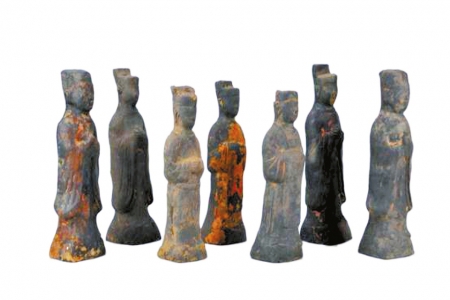
In August this year, in Group 14, Honghe Village, Longquanyi District, Chengdu, two three-color figurines were found after the construction workers dug more than two meters in the process of greenway reconstruction. Subsequently, the Chengdu Cultural Relics and Archaeology Team, together with the staff of Longquanyi District Cultural Relics Protection Management Office, rushed to the scene, and initially judged that there should be a Song Dynasty tomb group.
On August 28th, with the approval of National Cultural Heritage Administration, the rescue excavation officially began. By the end of November, 14 tombs of the Song Dynasty had been cleared.
Gong Yangmin, the leader of the archaeological excavation, said that the tombs were orderly distributed in the edge area of the circular platform, all in the north-south direction and arranged from east to west. The west area is a single-chamber tomb, and the tomb owners are all women. The north and east areas are two-room or three-room burial tombs for husband and wife. The tombs all have horizontal coupons, and the burial utensils are all wooden double coffins, and the inner and outer coffins are closely nested.
As written materials such as tombstones were unearthed from tombs, archaeologists confirmed the owner’s identity of this cemetery — — Descendants of Gao. Through written records, they learned that the Gao family originally lived in Bohai Sea, Shandong Province, and moved to Jiangxian County, Shanxi Province in the Northern Song Dynasty, and then moved south to Chengdu in the early years of the Southern Song Dynasty.
celebrity
Gao Keming, a painter of the Northern Song Dynasty, was buried here.
In the cemetery, archaeologists accidentally discovered the tomb of Gao Keming, a famous landscape painter in Renzong period of Northern Song Dynasty. Next to the tomb, the tombs of Gao Keming’s son Gao Jimin and his wife were also found, as well as the tombs of his grandson Gao Liangbi and his two wives. The owners of other tombs are closely related to the Gao family, and they also moved south to Chengdu with the Gao family in the early Southern Song Dynasty.
Gao Keming’s representative works include Three Dynasties’ Instructions, Xishan Snow’s Intention, Longevity Map, Establishment Map and so on. According to historical documents, during the reign of Renzong in the Northern Song Dynasty, Gao Mingke was ordered to draw a picture to test his talents, and then he was promoted.
Gong Yangmin said that Gao Keming is the chief supervisor (the sixth grade) of the Shaofu, and his daughter-in-law Jin’s grandfather is a county magistrate and his father is a Jinshi. It can be seen that Gao’s family is an official family in the Song Dynasty and can be called a local gentry. After the Anshi Rebellion in Tang Dynasty, China’s social system gradually changed from an aristocratic society to an aristocratic society, and the power of local clans in managing state and local affairs gradually increased. Gao’s family cemetery is a valuable material for studying this social change in China during the Tang and Song Dynasties. In addition, the source of the cemetery owner and his family is clear, which is of positive significance for studying the migration of the gentry and the integration of the north and south cultures under the trend of great social changes from the end of the Northern Song Dynasty to the beginning of the Southern Song Dynasty.
decode
Perfect female bones solve the custom of foot binding
On December 12th, in the Cultural Protection Center of Chengdu Institute of Cultural Relics and Archaeology, the reporter of Huaxi Dushi Bao-cover saw that 12 nails had been pulled out of a coffin. After the staff put on gloves and masks, opened the coffin lid and uncovered three layers of white cloth, a well-preserved female human bone appeared. The staff told reporters that when the tomb was discovered, there were signs of theft in the outer coffin. It was precisely because of the protection of 12 nails that the human bones and articles in the inner coffin were preserved. In order to keep moisture, they covered human bones with three layers of white cloth.
Due to the geographical environment of Chengdu, human bones are rare in previous archaeological discoveries. Now, through the study of the skeleton of this Zhang woman, it is expected to reveal what physical diseases women had in the Song Dynasty and whether there was a custom of foot binding at that time.
Most tombs in the cemetery have not been disturbed, and nearly 500 funerary objects such as pottery, porcelain, tin, bronze, lacquered wood, stone coupons and glassware have been unearthed. During the archaeological process, more than 10 pieces of exquisite lacquerware were extracted from the coffin. Gong Yangmin said that this is the first time in Sichuan that a well-preserved complete set of lacquerware of the Song Dynasty was discovered. Among lacquerware, the white porcelain cosmetic box and the cosmetics in the box reveal the female sentiment in the Song Dynasty, which provide valuable archaeological basis for studying the daily life of aristocratic women in the Song Dynasty.
In addition, archaeologists also found more than 60 stone coupons, such as the five-party authentic coupons, the Huagai Palace coupons, the Heaven Emperor’s gift coupons, the land purchase coupons, the epitaph, and the tomb.
Gong Yangmin believes that most of the tombs in the cemetery have not been disturbed, and the unearthed funerary objects are rich and the chronological materials are detailed. It can provide an important reference for the establishment of archaeological sequences in Sichuan from the early to the middle of the Southern Song Dynasty. The funerary objects unearthed from the tombs provide detailed archaeological materials for understanding the scientific and technological level, aesthetic and religious activities in the Southern Song Dynasty.