Foreign media pay attention! Europe’s appetite can’t eat American soybeans.
CCTV News:On July 29th, CCTV’s "International Sharp Review" published an article entitled "Europe has no appetite to eat American soybeans rejected by China", which was reprinted by many overseas media.
On July 29th, many overseas media, such as French Radio LCF facebook account, Italian RADIOWE website (facebook, twitter), Jordan Global Radio facebook account, Chinese PT portal, Chinese Headline APP, Portuguese New Newspaper APP(facebook, twitter), Nordic Times website, European Union Chinese website, Europe-China United Times website, West Africa online website, Africa Times website, Greek China website, Japanese Chinese Business website and so on, forwarded them one after another. From July 30th to 31st, this article was also published in Hong Kong Ta Kung Pao and Wen Wei Po. The main reports are as follows:
On July 25, US President Trump and visiting European Union President Juncker announced after more than two hours of talks that the United States and Europe agreed not to add punitive tariffs during the continuation of negotiations. This has pressed the pause button for the explosive escalation of trade friction between the two sides of the Atlantic.
In the past few days, around Trump’s "three zero plan" of "zero tariffs, zero non-tariff barriers and zero subsidies for non-automotive products", the disclosure of relevant details by the United States and Europe is "one paper statement, two interpretations".
At a political rally in Iowa, a large agricultural state in the midwest of the United States, Trump excitedly declared to the audience: "We just opened the door to Europe for you farmers … … You just got a huge market. " In order to increase the audience’s attention and visual effect, he also took out a green baseball cap with the yellow words "Let American farmers be great again" printed on it. However, recent poll data show that Trump’s popularity index is becoming dim in this state that supported him in the 2016 general election.
On the same day, US Trade Representative Wright Heze said categorically when attending the congressional hearing: "Our view is that we are discussing agriculture, period".
Unfortunately, on the other side of the Atlantic, EU officials said: "Agriculture is not a part (of the negotiations), only the matters explicitly mentioned in the statement are."
French President Macron and Spanish Prime Minister Sanchez also joined the fight. Macron said that he was not in favor of negotiating a huge agreement like the Transatlantic Trade and Investment Partnership Agreement (TTIP), because a good trade agreement can only be based on balance and reciprocity, and is not subject to any threats. He opposed the inclusion of agriculture in any trade agreement. "I don’t think any European standards should be suppressed or lowered in terms of environment, health or food."
Sanchez said that he would "defend the (EU) common agricultural policy". He said: "Spain does not believe in unilateralism, nor does it believe that a particular economy imposes its own policies and standards on others in international trade."
Why are the attitudes of Europe and the United States on agricultural issues so diametrically opposed?
As we all know, agriculture has always been a very delicate area in transatlantic trade, and both sides are trying to protect and enhance their respective agricultural production. According to EU data, the EU’s annual subsidies to agriculture are as high as 59 billion euros, equivalent to 68 billion US dollars. The United States is not too much to give. The Economist quoted data from the Organization for Economic Cooperation and Development (OECD) as saying that in 2016, the various subsidies provided by the US government to farmers were about $33 billion.
In fact, the sharp opposition between the United States and Europe on agricultural issues is one of the main reasons for the final abortion of the three-year transatlantic trade and investment partnership agreement negotiations. Europe put forward "Geographical indications", trying to prohibit American products with similar brand names from entering the EU market, which was resolutely opposed by the US. Europe also refused to allow American genetically modified products to enter.
All this reflects Brussels’ deep worries: the old family-run agricultural business model in Europe can’t compete with the modern business model of American collectivization, although the Wall Street Journal quoted American government statistics to show that the EU had a surplus of 9.4 billion US dollars in agricultural trade with the United States last year.
Although the leaders of some major EU countries refused to include agriculture in Trump’s "30" trade agreement negotiations, the EU still promised to push forward. EU spokesperson Mina • Mina Andreeva told reporters in Brussels: "If you read through the joint statement … … You will find that agriculture is not mentioned in the statement, but farmers and soybeans are mentioned, which is part of the discussion, and we will continue to promote it. "
However, does the EU really have the ability to help Washington solve the soybean dilemma caused by China’s counter-measures?
Bloomberg gave a negative answer. According to the report, the European market is one of the few substitutes for American soybean farmers, but it is far from China’s purchasing power. Last year, China imported 12.3 billion US dollars of soybeans from the United States, while the EU imported only 1.6 billion US dollars. It is estimated that the European demand for American soybeans in 2018-2019 is about 15.3 million tons, which is less than one-sixth of the original estimated purchasing power of China. The Trump administration launched a trade war against China, which led to China’s countermeasures, the loss of soybean sales to American farmers and the political pressure on Trump himself and Republican lawmakers in agricultural States, which Europe could not alleviate.

Reuters directly used the headline "Discount Not Discourses to Boost U.S. Soy Sales to EU" in his report, pointing out that the newly reached agreement between the United States and Europe is only symbolic for Europe to increase imports of American soybeans. Because, as early as before the White House meeting, due to market price reasons, the EU has started to increase imports of American soybeans. It is expected that the price of American soybeans arriving in August will be 20 dollars lower than that of South American soybeans per ton. A senior EU official told AFP that although Europe agreed to increase imports of American soybeans, the European market will ultimately decide the quantity of imports.
American Mother Jones pointed out that American soybeans account for about one-third of the EU’s total imports. Even if Europe increases its imports, it will have limited help to American soybean exports. Nowadays, under the background of foreign trade negotiations between Europe and the United States and financial subsidies from the United States, although the soybean price in the United States has rebounded to $8.59 per bushel, the analysis of the University of Illinois in the United States believes that unless the soybean price can rise to $10.05 per bushel, American soybean farmers will still be unable to make a profit.
For American soybean farmers, they need a stable export market rather than a government relief check, and the new European market that the Trump administration has found for them simply has no appetite to eat soybeans rejected by China. For more than 3.1 million farmers in the United States, the China market they have worked hard for decades is losing, which cannot be made up by relief checks.
A number of overseas media forwarded "International Sharp Review" articles:
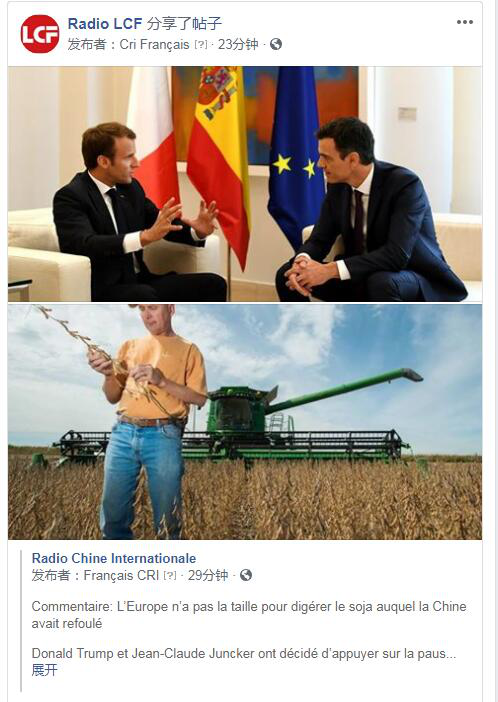
The facebook account of Radio LCF in France was forwarded on July 29, 2018.
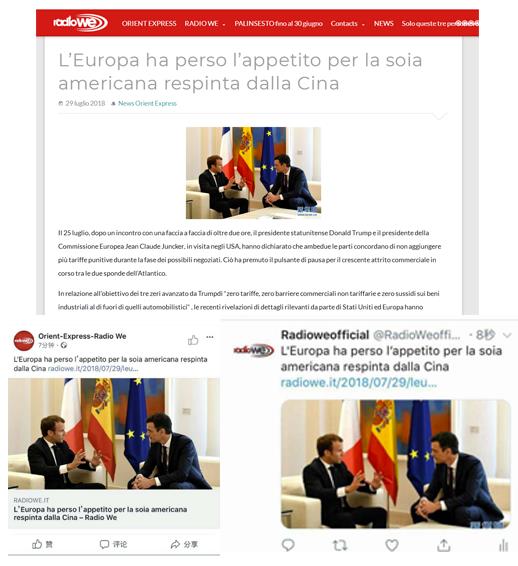
Italian RADIOWE website (facebook, Twitter) forwarded on July 29, 2018.
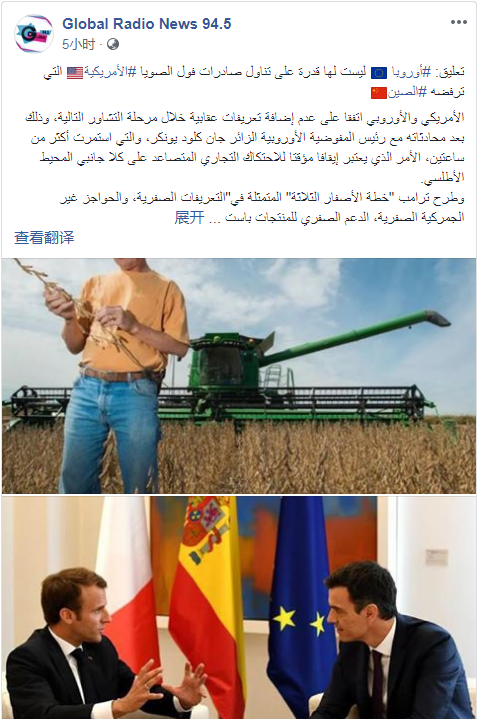
Jordan Global Radio facebook account forwarded on July 29, 2018
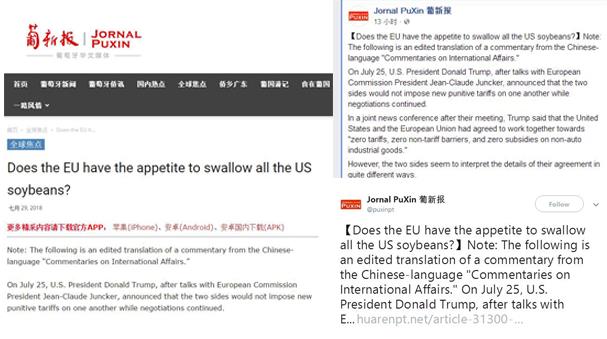
Portuguese news APP(facebook, Twitter) forwarded on July 29, 2018.
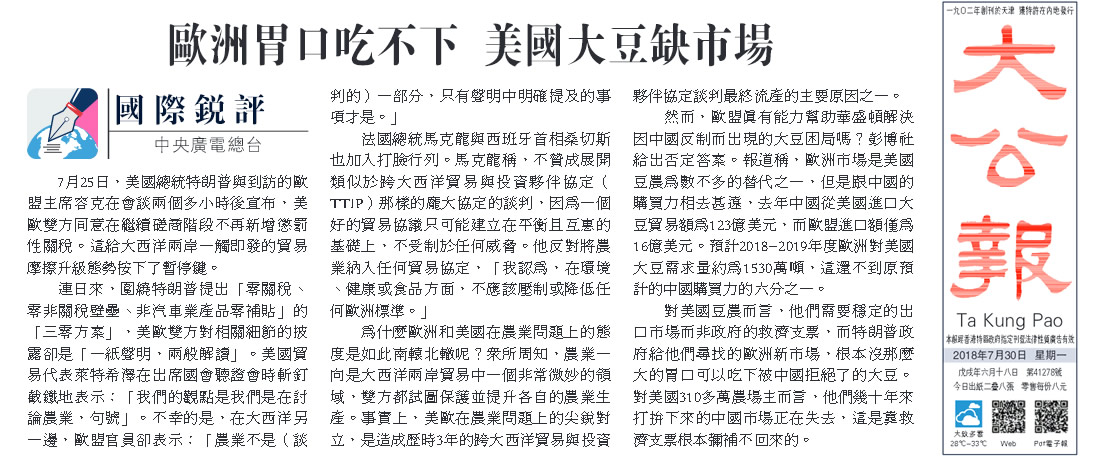
Hong Kong Ta Kung Pao was published on July 30, 2018
Hong Kong Wen Wei Po was published on July 31, 2018.