Is the biological transformation plan of the US Army Insect Alliance an agricultural project or a biological weapon?
Source: Global Times
Global Times reported Editor’s Note: The global food crisis triggered by the Russian-Ukrainian conflict has sounded the alarm for all countries in the world. With the superposition of climate change, environmental pollution and the reduction of available arable land, it can be predicted that in the next few decades, food security will become a key issue that has aroused widespread concern around the world. Recently, Russian President Vladimir Putin said that the establishment of a biological laboratory in Ukraine by the United States to study the transmission characteristics of dangerous diseases is essentially the development of biological weapons. The Russian investigation has also aroused widespread concern among people in many countries: is the US military’s attempt to spread genetically modified viruses to crops in the field by using insects an attempt of biological warfare weapons? Will this weapon eventually be used to artificially create a food crisis, thus serving American military purposes? In an interview with the Global Times reporter, many experts said that a project called "Insect Alliance" launched by the US military is turning this concern into a real danger. Foreign scientific and legal circles also pointed out that the relevant experiments of the US military are tantamount to opening a Pandora’s Box.
What is the intention of the US military to participate in the "Insect Alliance"
Defense Advanced Research Projects Agency (DARPA) is a scientific research institution under the U.S. Department of Defense, which specializes in developing high-tech for military use. On the official website of this institution, a biological transformation plan named "Insect Alliance" is listed impressively. The plan claims that it is seeking extensible, easy-to-deploy and popularized countermeasures to deal with natural and bioengineering factors that pose a potential threat to the food supply in the United States. The plan aims to protect the crop system in the United States. The plan points out that biological threats, including pathogens, drought, floods and frost, especially those brought by some state or non-state actors, will disintegrate the crop system in the United States, thus quickly endangering the national security of the United States. The "Insect Alliance" plan tries to reduce the impact of these threats by applying targeted therapy to mature crops.
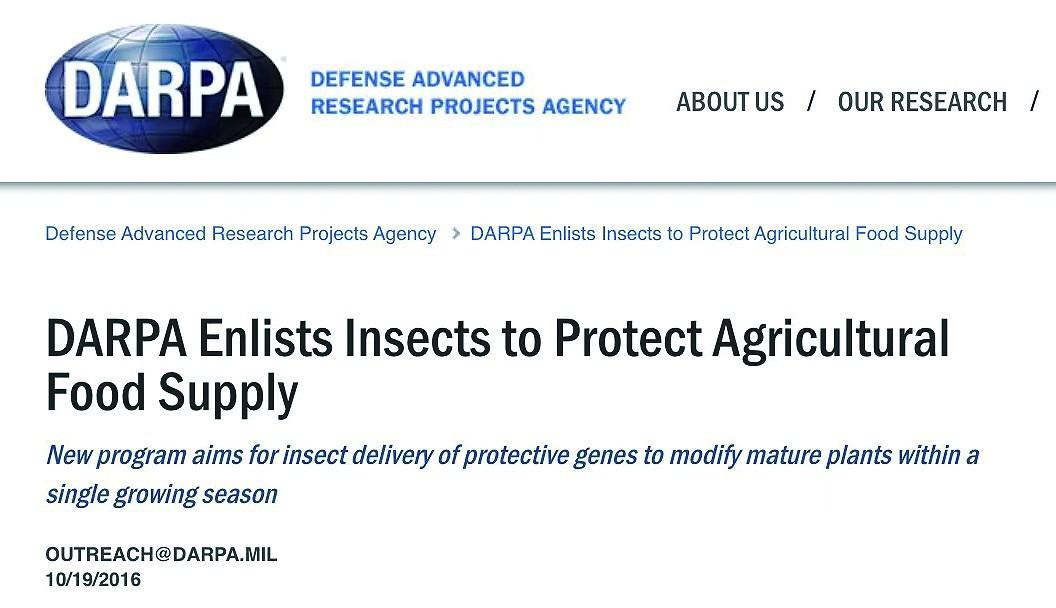
DARPA official website introduces the "Insect Alliance" project.
To this end, the US Defense Advanced Research Projects Agency envisages that insects can be used to deal with crop losses in emergencies. For example, when major crops in the United States, such as corn or wheat, are suddenly attacked by drought, natural diseases or biological weapons, these insects can carry genetically engineered viruses to achieve rapid deployment, and these viruses can be genetically modified in a single growing season to quickly protect crops. According to previous reports, the "Insect Alliance" program has provided financial support to four research institutions, including the Boyce Thompson Institute of Cornell University, Pennsylvania State University, Ohio State University and the University of Texas at Austin.
However, this plan, packaged as "disaster prevention and increase production", has been controversial since its publication. Science, a well-known American academic journal, once published an article entitled "Agricultural research or a new biological weapon system?" The article "questioned this plan of the US Department of Defense". In the paper, a group of scientists and legal scholars pointed out that the "Insect Alliance" program is tantamount to opening a "Pandora’s Box", because the attempt made by the program "may be generally regarded as an effort to develop a biological agent and its delivery tools for hostile countries".
In the report, Washington post quoted Guy Reeves, one of the authors of the article and a biologist at the Max Planck Institute of Evolutionary Biology in Germany, as saying that he directly expressed his opposition: "The plan of the US Defense Advanced Research Projects Agency is easy to be weaponized, instead of developing into a biological system that is conceived within a controllable range and used for agricultural development purposes."
The report also said that at present, the plan envisages three kinds of insects that are good at spreading diseases as "allies", namely aphids, leafhoppers and whiteflies. Because in nature, these three kinds of insects often spread viruses between plants. In terms of gene editing, the project has also made some progress, including the use of relatively cheap and simple "clustering regular interval short palindrome repeat sequence" technology, which enables researchers to develop customized viruses and achieve specific goals in infected plants. This engineered virus can "turn on or off" some genes in plants. For example, genes that control the growth rate of plants may play a role in severe drought. In this plan, the transgenic viruses carried by insects are called "horizontal environmental genetic modifiers", which can directly infect crops in the field and edit their chromosomes.
Violation of the Biological Weapons Convention?
Since its publication, the "Insect Alliance" project has been branded as a "biological weapon" by western scholars, which has triggered a big discussion in western academic circles and media about whether the project violates the United Nations Biological Weapons Convention.
Agricultural research, or a new biological weapon system? Warnecke, a professor of international law at the University of Freiburg, one of the authors of the article, said in an interview with Washington post that the Insect Alliance probably violated the Biological Weapons Convention, because there was a risk that the project would be regarded as inconsistent with peaceful purposes. "In international law, the decisive factor to judge whether a research is a biological weapon is whether a biological research project fully serves peaceful purposes. The Biological Weapons Convention requires all parties not to develop, produce, store or acquire microbial agents, toxins and their weapons except for peaceful purposes under any circumstances. "Warnecke believes that according to the Convention, using insects as a carrier for spreading viruses is a typical biological weapon. This is especially true considering that this technology can be easily used in biological warfare.
In addition, Warnecke believes that the use of insects as a key factor in this plan is particularly worrying, because insects can be secretly deployed by malicious people at a small cost. "We believe that the reasons provided by the Defense Advanced Research Projects Agency for peaceful purposes are untenable. For example, why do they choose insects to carry out genetic modification of crops? There are other ways to resist natural disasters. "
Guy Reeves believes that the key to the success of the "Insect Alliance" plan is that insects can spread the "horizontal environmental genetic modifier" to plants on a large scale, which may lead to the spread of insects to the land where non-GM crops are planted. "Almost all countries in the world can’t control its spread." Guy Reeves said.
"This technology talks about the large-scale release of genetically modified viruses by insects," Gregory Kay Bouhnik, an ethicist at the Institute of Bioethics in Hastings Center, new york, told the Associated Press that the technology of "Insect Alliance" may be destructive in the end. Kay Bouhnik questioned how to keep the virus-carrying insects under control. "When you talk about very small or microscopic organisms-you will find that once they are introduced into farmland, it is almost impossible to get rid of them.".
For the warnings from foreign media and foreign scholars, domestic experts also believe that from a scientific point of view, this is by no means alarmist. Jason, deputy director of the Institute of Plant Protection of the Chinese Academy of Agricultural Sciences, said in an interview with the Global Times that it is not only possible to attack crops by using insects to carry harmful bacteria and viruses, but also there is a lot of room for operation. Jason said that in reality, both rice and wheat have targeted pests, such as rice planthopper and wheat aphid, which can carry different viruses and infect rice or wheat, thus causing huge losses. "There are countless such examples. If insects are transformed into a biological weapon, it will be fatal, because so far, the virus of crops is difficult to prevent. Once the infection shows symptoms, it is almost impossible to save. Moreover, the virus will continue to mutate, and the prevention and control work is even more difficult. " Jason added.
At present, the "Insect Alliance" project is still advancing. In an interview with Washington post, the project leader Blake Bekstin said that the project had reached a milestone before, that is, it proved that aphids can infect mature corn plants with a modified virus, which contains a gene that can produce fluorescence.
Once the related technology is weaponized, it is dangerous.
Zhou Huanbin, a researcher at the Institute of Plant Protection, Chinese Academy of Agricultural Sciences, told the Global Times reporter that when editing crops, some principles must be followed. One of them is to minimize the risk of uncontrolled spread of genetically edited crops, and to ensure that endogenous genes are minimally modified, while exogenous DNA related to tools is completely eliminated.
Faced with all kinds of doubts, Black Bekstin, the project leader of the Insect Alliance, responded that the plan was entirely for peaceful purposes and had been reviewed by the US government agency responsible for agricultural safety, and the research agreement included multi-layer safeguard measures, including comprehensive control of insects.
"I don’t think the public needs to worry, nor does the international community need to worry," Blake Bakerstin said. However, he also admitted that the new technologies involved in the "Insect Alliance" may have "dual uses" because theoretically, these new technologies can be used for both defensive and offensive purposes. But he said that almost all advanced technologies are like this. "I believe that whenever a new and revolutionary technology is developed, it is possible to have a dual effect of attack and defense. But this is not what we are doing. We focus on positive purposes and hope to ensure food security in the United States, "argued Blake Bakerstin.
He also said that there are multiple protection measures to ensure whether this technology will get out of control and have unexpected ecological impact, which many scholars are worried about. The plan does not target the germ cells of plants, so it will not lead to changes in plant genetic traits. The goal of DARPA is to find a way to improve plants temporarily and beneficially in a single growing season.
However, this statement has been criticized by Agricultural Research, or a new biological weapon system? The author’s team of five refuted that they pointed out in their official website that the first scientific publication sponsored by the Insect Alliance in 2020 indicated that the chromosomes of mature plants mediated by the technology of "clustered regularly spaced short palindrome repeat sequence" had hereditary changes, which contradicted the explanation of Blake Bakerstin and his team members.
At the beginning of this year, an evaluation paper published by Kevin Pfeiffer, Johannes Fries and Bernd Gith from the University of Natural Resources and Life Sciences in Vienna, Austria, on PubMed, the medical literature platform of the National Biotechnology Information Center of the National Library of Medicine, bluntly pointed out that the "Insect Alliance" project of the US Defense Advanced Research Projects Agency has triggered scientific debates on related issues, the most common of which is the dual use of this project. In addition to peaceful applications, this technology also provides a blueprint for potential biological weapons. The combination of virus-induced genetic modification of crops in the field using transgenic insect vectors is more risky than any transgenic organism used so far.
Although the Defense Advanced Research Projects Agency (DARPA) is secretive about the military use of "Insect Alliance", in the view of military experts, this agricultural project led by US defense research institutions is undoubtedly a biological weapon. Song Zhongping, a military expert, said in an interview with Global Times that "Insect Alliance" is a typical form of biological weapons. Insects are used to carry a certain virus and realize the transformation of plant genes. The purpose is to reduce crop production in target countries, artificially create a food crisis in these countries, and then lose their independence in the food field and become dependent on American food exports, including genetically modified food. This is part of the biological war.
Song Zhongping believes that the United States really needs to explain why insects are used as vectors in this study, especially considering that when these insects are taken as research objects, the corresponding virus genes can be quietly injected into crops in other countries, and the genes of crops can be changed. "It is not difficult to understand why the United States will set up biological laboratories around some rival countries, because only by setting up biological laboratories in these places can we ensure the localization of biology, such as the localization of insects. For example, you can’t take American insect varieties to neighboring countries in Russia and then release them to Russia, so it is easy to see flaws. Therefore, this research in the United States is a Pandora’s Box. Once it is opened, it will inevitably cause a domino effect and lead to a series of disasters, "Song Zhongping said. (Reporter Fan Wei Shan Wei)
Reporting/feedback